Before the Masterpiece: How Oil Sketches Became the Smart Collector's First Buy
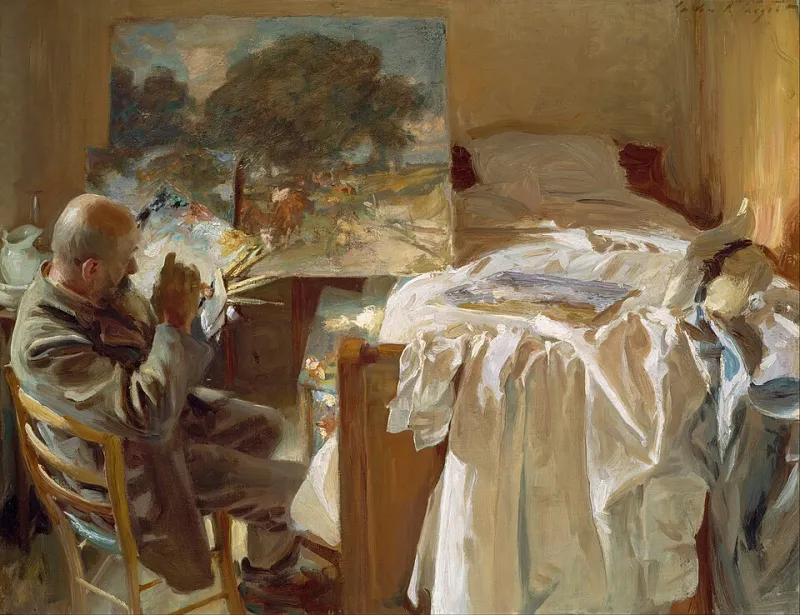
Photo: John Singer Sargent, Public domain, via Wikimedia Commons
In a second-floor studio above a hardware store in Albuquerque, a painter we will call M. — she asked that her market activities remain separate from her exhibition practice — keeps a flat file stuffed with small oil sketches that, until eighteen months ago, no one had ever asked to see. Today, three of them are spoken for before they leave the drawer. Each sold for less than a tenth of what her finished canvases command. Each, she says, felt harder to let go of than the large paintings ever do.
This is the quiet reshuffling happening across the American art market: the preparatory work, long treated as scaffolding to be discarded or archived, has become a commodity of its own.
The Logic of the Underpainting
The economics are not difficult to understand. As prices for finished paintings by mid-career American artists have climbed well past what first-time collectors can absorb, dealers have started looking downward — not in quality, but in scale and finish. A color study at eight by ten inches, priced accessibly, gives a new collector a foothold in an artist's practice before the primary market closes the door.
A dealer in Santa Fe who has organized two recent exhibitions of works on panel and paper describes the shift bluntly: "Five years ago, a sketch was a gift for a museum donor. Now it's a product line. And honestly, the collectors who buy them are often the serious ones. They understand they're acquiring the decision, not just the result."
What Exactly Is Being Sold?
The category is broader than the term "sketch" suggests. It includes:
- Oil sketches on panel or paper — small, rapid explorations of composition, often painted in a single sitting
- Color studies — charts and small trials where an artist resolves a palette before committing to a large canvas
- Maquettes and painted constructions — three-dimensional models for works that may never be fabricated
- Working drawings with paint — the hybrid objects that live between drawing and painting, neither fully one nor the other
What unites them is incompleteness by design. These are objects made to answer a question, not to hang on a wall. Which raises the question of what a buyer actually owns.
The Authenticity Problem, Inverted
Traditionally, the art world's anxiety about unfinished work ran in one direction: was it really by the artist, or a studio hand? The sketch market inverts the concern. These works are emphatically by the artist — often more directly so than the finished canvas, which may involve assistants, fabricators, or months of refinement. The risk is not authorship but intent.
Several painters interviewed for this article expressed a version of the same unease: that selling studies removes the evidence of struggle from the studio, leaving the finished work to appear more inevitable than it was. One painter in the Hudson Valley has begun photographing every study before sale, keeping the image but releasing the object. "I want the archive to show the wrong turns," she says. "The collector gets the object. I keep the proof that it was hard."
Pricing the Unfinished
For dealers, the sketch market has introduced a novel pricing problem. Without the anchoring logic of size and finish, values rest on proximity to a known finished work — a study directly related to a painting that later sold well can command a striking premium — and on the artist's overall market trajectory.
Some advisors now counsel collectors to treat sketches as they would early works on paper: as entry positions whose value tracks the artist's career rather than the intrinsic merit of the object. It is a longer, less certain bet. It is also, notably, one that brings the collector closer to the artist's mind than a finished wall piece ever could.
A Very American Market
There is something fitting about this development in the American context. The oil sketch has a distinguished lineage — the bozzetti of the Italian Renaissance, the painted studies of Delacroix and Cézanne — but its commercial revival here owes less to history than to structure. A decentralized market of regional galleries, art fairs in secondary cities, and direct-from-studio sales has created room for price points and formats that the primary market's traditional gatekeeping never accommodated.
Collectors in Dallas, Portland, and Nashville — cities where the painting market has grown without the inventory of New York or Los Angeles — have proven especially receptive. When finished canvases by in-demand artists are scarce, the study fills the gap.
Owning the Question
Back in Albuquerque, M. has made peace with the drawer emptying out. Her view is pragmatic: the studies fund the months that the large paintings take, and the collectors who buy them tend to become the collectors who eventually buy the canvases. "They're buying the first half of a conversation," she says. "Some of them come back for the second half."
Whether the sketch market represents a genuine democratization of collecting or simply a new tier in the same old hierarchy remains an open question — one that, fittingly, may never be finished.