The Collector's Living Room: How Domestic Walls Became America's Most Serious Gallery Space
In a brownstone in Chicago's Logan Square, a 1970s abstraction by a little-known Milwaukee painter hangs beside a contemporary still life from Santa Fe. Nothing about the arrangement is casual. The spacing was measured, the sightlines tested, the picture lights color-matched to the warm tones in the canvas. The homeowner, a hospital administrator in her fifties, keeps a rotating schedule on a shared calendar app: each spring and fall, several works come down, others go up.
She is not an outlier. She is representative of a quiet transformation in how Americans collect painting.
From Storage Unit to Salon Hang
For decades, the default mode of serious American collecting was acquisitive and inert: buy, insure, store. Work went to freeports, climate-controlled warehouses, or — worse — remained crated in basements. The home, when it entered the picture at all, was a backdrop rather than a framework.
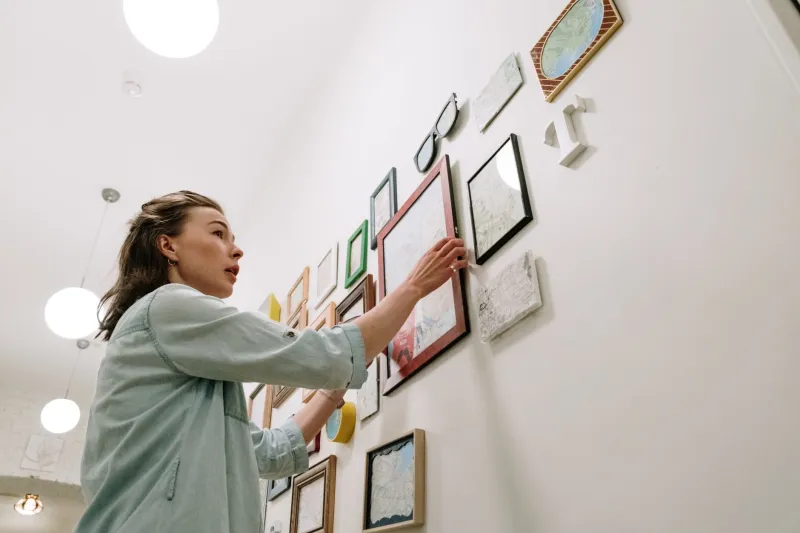
That model is losing ground. Interior designers report a surge of clients who arrive not with a mood board but with a holdings list. The term surfacing in trade conversation is the "salon hang": a dense, floor-to-ceiling arrangement of paintings and works on paper, deliberately clustered rather than sparsely spaced. Its revival signals a shift in intent. These collectors are not decorating. They are exhibiting.
The difference is visible in the details. Picture rails are being installed in new construction. Adjustable LED track lighting calibrated to conservation standards — no ultraviolet, low heat output — is now a routine line item in residential renovation budgets. One designer in Richmond, Virginia, describes clients who request wall sections reinforced to bear the weight of large canvases before the drywall goes up.
Placement as Criticism
What distinguishes this new domestic connoisseurship is that it treats hanging decisions as interpretive acts. Which painting commands the wall opposite the front door is a statement about arrival. A small, demanding work placed in a hallway forces the viewer to slow down. Pairing a regional landscape with an urban abstraction initiates a conversation the collector is, in effect, authoring.
Collectors interviewed for this piece describe their walls in curatorial vocabulary: "the anchor piece," "the counterweight," "the transitional work." Several maintain written records of each work's placement history — where it hung, next to what, for how long. One Dallas collector keeps a spreadsheet.
This is connoisseurship in its most engaged form. Unlike a museum visitor, the domestic curator lives with the consequences of every hanging decision, revising daily as light shifts and seasons change. The knowledge that accumulates is intimate and specific: how a particular oil reads at seven in the morning versus nine at night, how a canvas's surface changes under lamplight in February.
What This Means for Painters
For artists, the rise of the lived-with collection carries practical consequences. Work sold into these homes will be seen constantly, at close range, under varied light — conditions no museum can replicate. Surfaces must hold up. Edges matter. A painting that rewards a hundredth viewing, rather than exhausting itself in one, has a market advantage.
Gallerists note a corresponding shift in sales conversations. Collectors increasingly ask where a work has been shown in domestic settings, or request photographs of the piece in a residence rather than on a gallery wall. Some artists now document their own work in home contexts, understanding that the domestic hang has become a legitimate — arguably the most credible — form of proof that a painting endures.
There is also a market implication for scale. The salon hang favors medium and small works that can be grouped, which may explain why the market for modestly sized paintings has held firmer than the oversized canvases that dominated the last speculative cycle.
The Wall as Institution
Skeptics will note that private display is nothing new; the salon hang takes its name from nineteenth-century Paris, and American parlors were hung densely a century ago. What is new is the self-consciousness. Today's domestic collectors know they are curating. They read the labels, track the provenance, and treat rotation as a discipline.
In an era when museum tickets require advance booking and biennial attendance has become a tourist logistics problem, the most accessible exhibition space in America may be the one behind a collector's own front door. The wall, it turns out, was never neutral. It is the most contested — and most personal — curatorial territory in the country.