The Studio Door Swings Open: How Direct-from-Artist Buying Is Rewriting the American Art Market
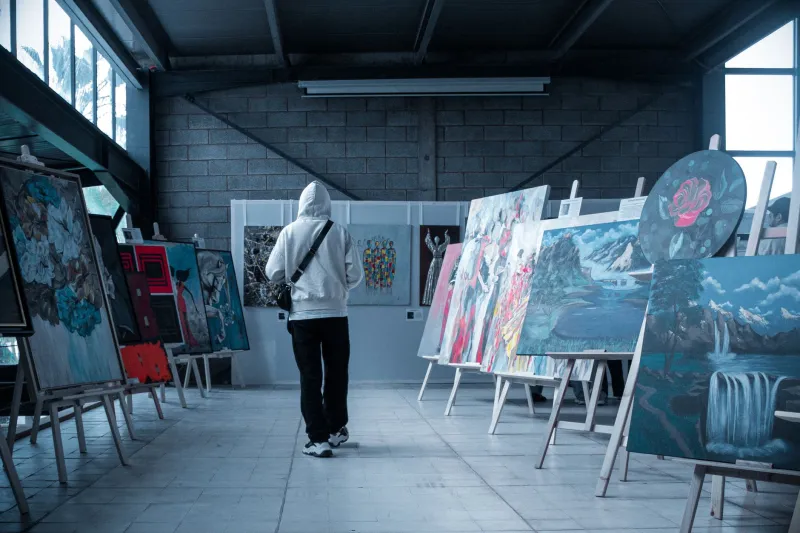
There was a time when buying contemporary painting in America meant one thing: a gallery. A white-walled room, perhaps on West 24th Street or in the La Brea corridor, a discreet price list, and an intermediary who decided whether you were ready to own the work. That model has not disappeared — far from it. But across the country, a quieter transaction is taking place in converted warehouses, garage studios, and living-room salons: the collector standing face to face with the painter, the work still wet, the conversation unmediated.
A Return to the Oldest Model
The irony is that the studio visit is not a new phenomenon. It is, in fact, the original one. Before the modern gallery system crystallized in the twentieth century, patrons visited ateliers; the transaction was personal, contextual, and often social. What we are witnessing today is less an innovation than a recovery — a return to a relationship that the white cube, for all its curatorial rigor, deliberately obscured.
Several forces have converged to make this recovery possible. The pandemic normalized remote studio tours and made collectors comfortable evaluating work over video calls. Instagram flattened the distance between artist and audience, turning a painter's feed into a de facto exhibition space. And a generation of younger collectors — many in their thirties and forties, spread across cities far from Chelsea — has grown skeptical of gatekeeping. They do not want to be discovered by a gallery; they want to discover an artist.
What the Numbers Suggest
While hard market data on direct sales remains patchy, the direction is unmistakable. Open-studio events from Chicago's west side to Oakland's Jingletown report record attendance. Online platforms built around direct artist sales have matured, and artists themselves speak openly about the economics: a studio sale, even at a lower price point, often nets the painter more than a gallery transaction after commission. For the collector, the appeal is equally practical — pricing is more transparent, relationships are genuine, and the work arrives with a story rather than a certificate of cool.
None of this renders galleries obsolete. A serious gallery still does what no studio visit can: contextualize an artist's career, place work in institutional collections, and steward a painter's market over decades. The most thoughtful artists in the contemporary orbit — including many whose work we champion at Sariev Art — treat galleries and direct sales as complementary channels, not rivals. The friction arises only when the boundaries are unclear.
A First-Timer's Field Guide
For collectors considering their first direct purchase, a few principles go a long way.
Do your homework before the visit. Follow the artist's work for a season. Watch how it evolves. A studio visit is a conversation, and it goes better when you arrive knowing the arc of the practice.
Ask about provenance and paperwork. Even an informal sale should come with an invoice, a certificate of authenticity, and clarity on condition and framing. Reputable artists expect these questions; hesitation on their part is a signal on yours.
Understand pricing logic. Studio prices are often below gallery prices for good reason — the artist saves on commission and you may be buying work from an earlier stage of the career. Ask how the artist prices across channels. Transparency here protects the relationship.
Respect the process, not just the product. Don't ask for discounts on work that isn't finished. Don't request commissions that pull a painter away from the practice you admired in the first place. The best direct relationships are patronage, not procurement.
Think long-term. If the artist later joins a gallery, your early support will be remembered. Consistency matters more than size; a modest purchase made early often means more to a painter than a larger one made late.
What Galleries Should Learn
The gallery model will not be replaced, but it is being renegotiated. The dealers who thrive will be those who embrace transparency — publishing prices, welcoming young collectors, and acknowledging that the artist's studio is no longer a back-of-house space but a public-facing venue in its own right. The galleries that resist may find that the collectors they declined are already knocking on a different door.
For the American collector, the moment is genuinely promising. The distance between the person who makes the work and the person who lives with it has never been shorter. All that remains is to open the door.