Instructions for the Dark: The Painters Telling Conservators to Stand Down
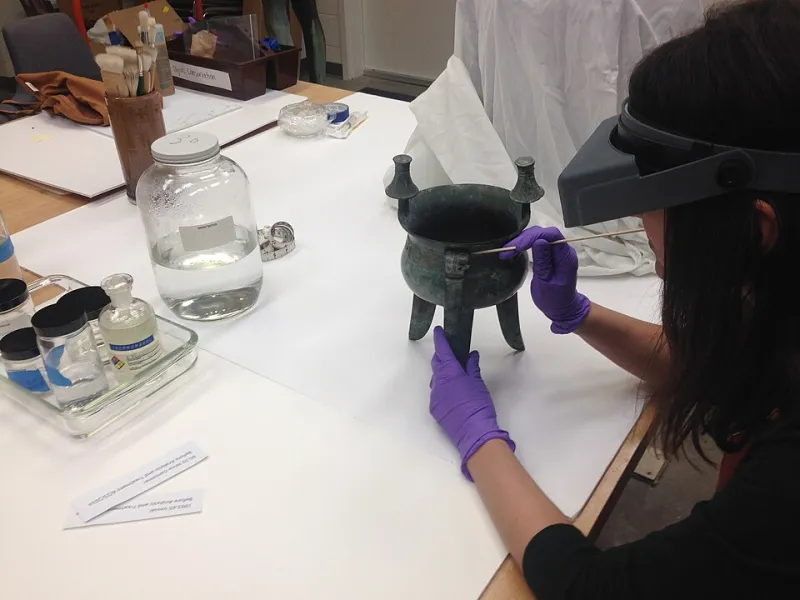
Photo: RichardMcCoy, CC BY-SA 3.0, via Wikimedia Commons
In the conservation lab of a mid-sized American museum, the most consequential document in the room is often not a painting at all. It is a single sheet of paper — an artist's instruction, sometimes handwritten, sometimes notarized — dictating what may and may not be done to a work decades after its maker is gone. Increasingly, that document contains a phrase that would have been unthinkable a generation ago: do not restore.
The movement is small but growing, and it is forcing a genuine philosophical argument inside the discipline. When a varnish yellows, when a cadmium shifts toward pallor, when craquelure spreads across a surface the artist once worked to a mirror finish — is that damage, or is it biography?
The Clause in the Estate
Estate planning has always been part of an artist's professional life, but its contents are changing. Where earlier generations specified which galleries could handle their legacy or which museums might receive bequests, a rising number of contemporary painters are drafting explicit material instructions: no revarnishing, no inpainting, no surface cleaning beyond the most conservative measures.
The logic is not neglect. It is authorship. These painters argue that a painting is not a fixed image but a material event — one that includes its own decay. Correcting the decay, they contend, produces a forgery of sorts: a picture that looks like the work but no longer is the work.
Conservators, predictably, are divided. The profession's founding instinct is intervention — the careful, reversible arrest of deterioration. A blanket refusal complicates that mission at its root.
Two Philosophies of Time
The debate maps onto a familiar fault line in American art. On one side stands the tradition of the Old Masters, for whom retouching was routine and the collaboration between painter and future restorer was assumed. On the other stands a more recent conviction, traceable through Postmodernism and into studio practice today, that a work's aging is not an accident visited upon it but a process it performs.
"If I wanted the painting to look like that forever, I would have made it out of something else," one painter told us, describing the language she has written into her own estate. Her position is not unusual among painters under fifty who work with deliberately fugitive materials — unvarnished oil, wax, unprimed linen, pigments known to shift within a decade.
Conservation science complicates the romance. Modern retouching is reversible to a degree earlier restorers never achieved, and synthetic varnishes can be formulated to remain clear for a century. The tools of restraint, ironically, are better than ever. The question is whether restraint itself should be the default.
What the Collector Should Ask
For the American collector, the debate is no longer academic. Works purchased this decade may come with material instructions attached, and the secondary market — auctions, estate sales, gallery resales — will increasingly have to answer for them.
Buyers would do well to ask three questions. First, does the artist's studio or estate maintain written material guidelines, and do they transfer with the work? Second, is the painting's condition documented at the moment of sale, so that future change can be distinguished from past mishandling? Third — and least comfortably — is the collector prepared to live with a painting that will not stay the painting they bought?
Some will find that prospect clarifying rather than disturbing. A painting that changes on the wall is a painting that keeps requiring attention, and attention, in the end, is the only real currency of collecting.
The Ethics of the Long View
There is a harder question underneath the market questions, and it belongs to criticism rather than commerce. Restoration has always operated on an ethics of the viewer's present: we fix the painting so that we may see it well. The do-not-restore movement substitutes an ethics of the artist's future — the painting is preserved as authored, change included, even when the change diminishes what we can see.
Neither position is self-evidently correct. The museum conservator who lifts yellowed varnish to reveal a passage of color the artist intended is performing an act of fidelity. So is the estate that seals an archive and refuses all intervention. What both are protecting is intention — they simply locate it at different points in time.
What seems certain is that silence is no longer an option. Every painter working today is, whether they know it or not, drafting an answer to the question of how their work should age. The ones writing it down are simply the first to admit it.