Before the Crate: Three Studio Visits Behind the Finished Canvas
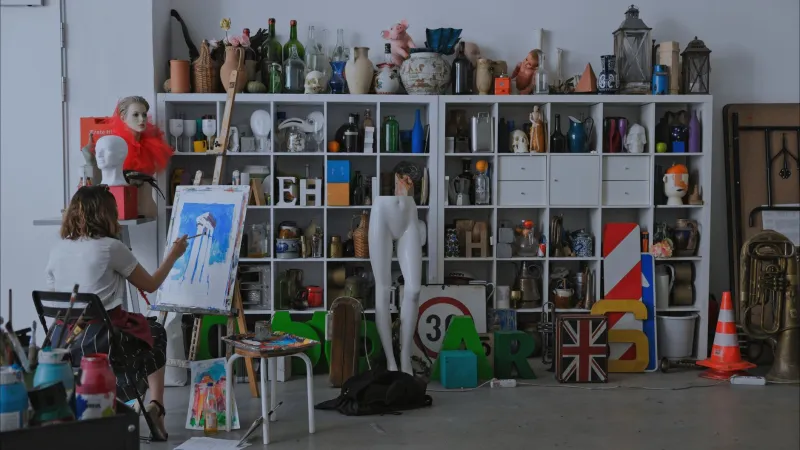
The gallery is a stage set. Lighting is calibrated, walls are freshly painted, and every canvas hangs at the precise center of an invisible grid. What the visitor sees is the final sentence of a long, messy paragraph. To understand the sentence, you have to visit the room where it was drafted.
We did exactly that, sitting down with three painters in the weeks before their exhibitions, watching work move from easel to crate and asking the questions the gallery opening rarely answers.
Detroit: The Garage That Holds a Practice
On Detroit's east side, a two-car garage with a space heater and a salvaged library ladder serves as the studio of a painter preparing twelve canvases for a fall exhibition. The scale of ambition versus the scale of the room is the first thing a visitor notices: several works measure six feet across, and there is no wall on which to see any of them whole.
"I paint in sections," she explains, stepping back onto the driveway to squint at a canvas propped against the doorframe. "You learn to trust what you can't see."
Her process is unglamorous and iterative — underpaintings abandoned, scraped, restarted. A stack of failed canvases leans in the corner, which she calls, without irony, "the tuition pile." When the conversation turns to pricing, she is blunt: the gallery takes half, materials are not cheap, and the math only works because her overhead is a garage, not a loft. The romantic image of the Detroit artist is, she notes, a discount she pays in insulation.
Santa Fe: Adobe Walls and the Discipline of Light
Two hundred miles of high desert away, in a sunlit adobe annex behind a historic home, a second painter works in near-silence. His exhibition prep looks almost liturgical: pigments ground by hand, brushes arranged by stiffness, a full day spent simply observing how afternoon light falls on a nearly finished landscape before he commits a single correction.
"Out here, the light is a collaborator and a critic," he says. "It tells you when a painting is lying."
His pre-show ritual involves living with each finished work for a week on the studio wall before releasing it. Collectors sometimes mistake this deliberateness for slowness; in truth, it is quality control of the most old-fashioned kind. He is also candid about the commercial machinery: the certificate of authenticity drafted before the varnish dries, the documentation photographs taken under north light, the careful wording of condition reports.
Brooklyn: The Walk-Up and the Final Ten Percent
Our third visit lands in a narrow Brooklyn walk-up where a painter is in the final stretch before installation. Here the gap between studio and gallery is at its most visible. Her canvases are done; the remaining work is everything the audience never sees — varnishing under a respirator, building crates from Home Depot lumber, drafting the wall labels, debating with her dealer over which of two canvases should anchor the room.
"The last ten percent of a show is logistics," she says, taping a corner protector. "And logistics is where careers quietly succeed or stall."
She walks us through the pricing conversation she wishes more collectors understood: not a number pulled from ambition, but a structure — materials, time, gallery commission, and the career stage that determines whether a work can rise in price at all.
What the Studio Reveals
Across three rooms, three climates, and three very different practices, one truth held constant: the finished canvas is a compression. Every drip, restart, and doubt has been edited out of view. Criticism that judges only the staged result misses half the story.
The studio visit remains the most honest form of art writing available. It should happen more often — and collectors would be wise to ask for one before they ask for a discount.