Degree of Hype: Inside the MFA Machine That Decides Who Gets Seen
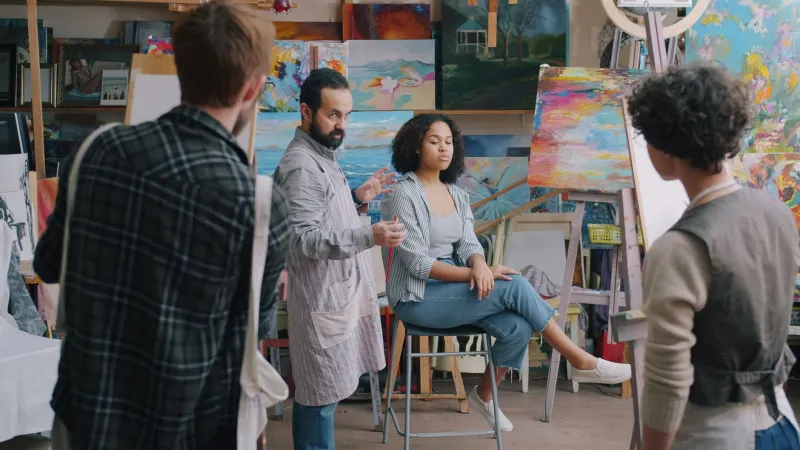
The open studio is the new vetting room. Every spring, dealers from New York, Los Angeles, and increasingly Chicago and Mexico City walk the corridors of a handful of graduate painting programs with the focused air of scouts at a regional combine. They are not looking at everything. They are looking at Yale, at UCLA, at RISD, and at a short list of programs whose graduating cohorts have, over the past two decades, produced a disproportionate share of the artists now hanging in blue-chip galleries.
The question worth asking — uncomfortable, but overdue — is whether the MFA has quietly replaced the gallery opening as American art's real gatekeeper.
A Pipeline by Any Other Name
No program advertises itself as a feeder system, and the professors we spoke with bristle at the framing. "We're teaching painting," one senior faculty member at a top-ranked program told us, asking for anonymity because, in his words, "the admissions conversation is not one I'm permitted to have honestly." But the numbers do the talking. A review of rosters at several major American galleries reveals that graduates of five or six programs account for a striking share of their emerging and mid-career painting slots.
Dealers are candid about why. "It's a diligence shortcut," a New York-based advisor explained. "A Yale MFA comes pre-vetted by faculty who are themselves serious painters, by a peer group that competed for twelve slots out of eight hundred applications, and by a network that will champion the work for years. I can underwrite that risk. I cannot underwrite the unknown painter in Dayton."
That word — risk — is doing a great deal of work in the contemporary market. Galleries, squeezed by fair fees and artist guarantees, have less appetite for unproven talent than at any point in memory. The MFA functions as a proxy for proof.
What the Degree Actually Buys
The honest answer is not skill. Plenty of painters outside the pipeline are technically formidable. What the degree buys is time, legitimacy, and — most crucially — witness. Two years of protected studio practice, a thesis exhibition attended by the right people, and a cohort that becomes an informal mutual-advancement society. One painter who declined the MFA route put it plainly: "The degree doesn't make you a better artist. It makes you a known artist. Those are different problems."
She is not wrong. And the market's reliance on institutional witness has consequences that reach well past the careers of individual painters.
The Cost of the Funnel
First, there is the tuition problem. Top programs routinely cost well into six figures, which means the pipeline skews toward artists who can either absorb that debt or carry family resources. The result is a market narrative — the painter as risk-taker — that quietly excludes anyone who cannot afford to take the risk.
Second, there is the homogeneity problem. When a small number of faculty judge a small number of applicants and a small number of dealers buy the output, taste converges. Look at any recent round of biennials and you will see it: a recognizable register of painting, competent and current, that reads as though it emerged from a shared syllabus. Some of it is excellent. Very little of it is surprising.
Third, and most corrosive, is the credibility problem. Collectors are told they are buying the next generation. Increasingly, they are buying the next graduating class — a distinction that matters when the market corrects and the work must stand on its own.
The Road Less Funded
It would be lazy to suggest the pipeline is the whole story. Painters outside it do break through, usually by way of alternative exhibition spaces, regional museums, or the direct-from-studio sales that online platforms have made viable. Several of the most compelling painters we have covered on this site built their audiences one collector at a time, without institutional blessing.
But they did it against the current, and the current is strengthening. As more galleries adopt the scouting model, as more collectors treat the MFA as a seal of quality, the degree consolidates into something it was never meant to be: a license to be seen.
A Modest Proposal for Collectors
Collectors are not powerless here, and they hold more leverage than they realize. Buy from unaffiliated painters. Attend MFA exhibitions beyond the famous three. Ask your dealer who they have seen recently outside their usual circuits, and notice how they answer. The market follows attention, and attention is a decision collectors make one purchase at a time.
The MFA will remain a powerful institution, and for many artists a genuinely formative one. But a healthy American painting scene cannot be farmed from a half dozen studios. The most interesting wall in a decade from now may well belong to someone who never got the visit.